ThaiFusion Botanica
Monstera Deliciosa White Lava Ghost
5.0 / 5.0
(1) 1 total reviews
Couldn't load pickup availability
Monstera deliciosa White Lava Ghost pushes variegation about as far as it can go before a leaf stops being viable at all. A mature leaf can be entirely white, with only a thin trace of green, but most settle into a more balanced marbled mix of green and cream. Even the plantlet stage shows this tendency early: young leaves emerging from the tissue culture gel are already mostly cream-white, with green confined to irregular patches along the margins rather than spread evenly across the blade.
The Appeal of Pushing a Sport to Its Limit
Most white-variegated Monstera settle into a workable balance of green and white so the plant can reliably photosynthesize. White Lava Ghost is valued specifically because it doesn't play it safe: leaves this close to fully white are harder to produce, harder to keep alive, and correspondingly harder to find in the trade. Collectors chasing the most extreme expression of a variegated sport, rather than the safest one, are exactly who this plant is for.
Why So Much White Is a Gamble
The white sections of a variegated leaf are white because that tissue lacks chlorophyll entirely and can't photosynthesize. A normal variegated plant gets away with this because enough green tissue remains to feed the whole leaf. Push the white ratio too far, and a leaf, or the whole plant, can simply run out of energy to sustain itself. That's the real reason a heavily white Monstera like this one commands more attention and a higher price than a modestly variegated one: it's not just rarer to look at, it's genuinely harder for the plant itself to pull off.
Giving the Green Enough to Work With
Because so much of the leaf can't photosynthesize, protect what green tissue there is: bright, indirect light suits it best, strong enough to support growth but not so direct that it stresses an already energy-limited plant. Keep humidity on the higher side, the growing medium evenly moist, and temperatures warm and stable. This is not a beginner's Monstera; consistency matters more here than it does for a fully green plant.
What Your Plantlet Will Actually Look Like
This listing is a laboratory-propagated tissue culture plantlet, grown in sterile in-vitro conditions rather than divided from a parent plant. Even at this early stage, the variegation tendency is already visible: young leaves emerge mostly cream-white with green confined to the margins, well before the plant reaches the size and fenestration shown in the mature reference photograph. Because this kind of variegation isn't a fixed, seed-true trait, no two plantlets from this line are guaranteed to develop the same balance of white to green as they mature.
For Collectors Ready to Go This Far
Add Monstera deliciosa White Lava Ghost to a collection that's ready for its most demanding variegate, or let it be the plant that raises the bar for everything else in it. ThaiFusion Botanica propagates and ships this variety directly from our nursery in Thailand, with a phytosanitary certificate included on every international order.
Shipping
Shipping
We ship our plants with free Phytosanitary Certificate via the national postal services, Dragon Courier and courier companies such as DHL and UPS. Some countries require an import permit.
Please refer to our Delivery & Packaging page for more details. We do not ship on public holidays in the Kingdom of Thailand.
Packaging
Packaging
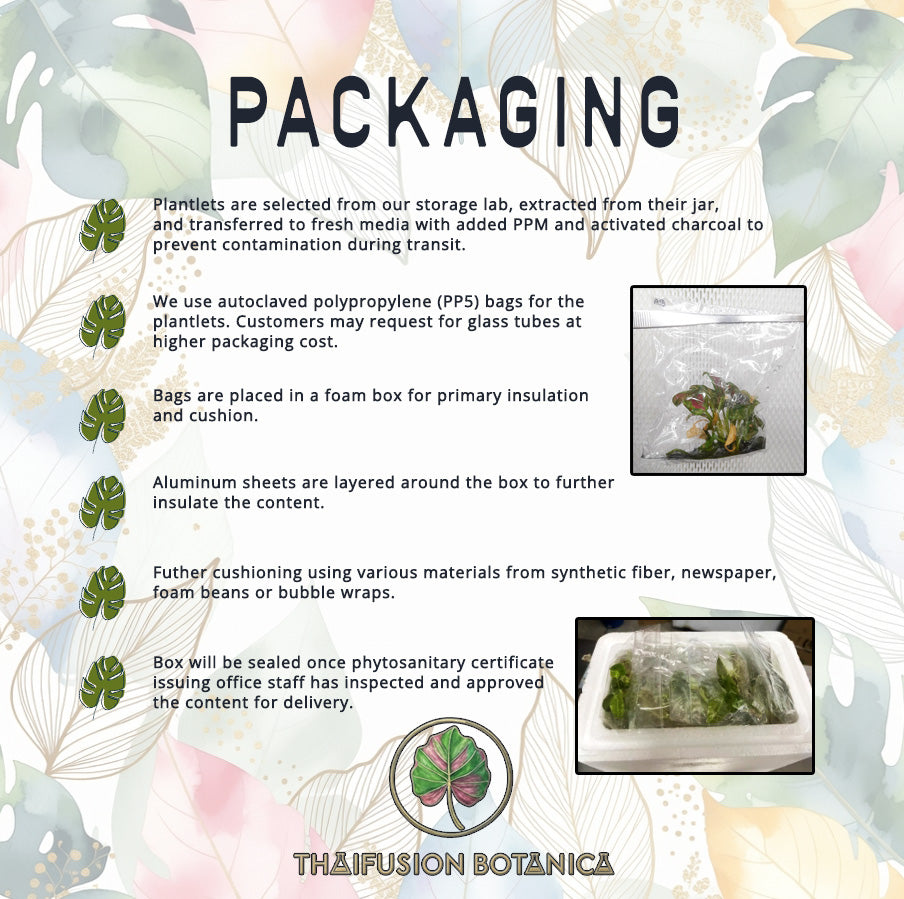
We ship our tissue culture plants in foam box lined with insulating material to minimize thermal shock.
Live plants are shipped in carton boxes with ventilation holes to prevent excessive moisture from building inside the parcel.
Please refer to our Delivery & Packaging page for more details. We do not recommend importing live plants if your area experiences temperature below -5 degree Celsius.
Disclaimer
Disclaimer
Our photos are representative examples of the plants we offer. You will receive a healthy plant of similar size and quality unless the product description clearly states that the listing is for the exact plant shown.
For selected products, actual photos of the individual plant are provided. These listings will be clearly identified, and you will receive the exact plant pictured. The date the photos were taken will also be stated. If the photos are older, you are welcome to contact us to request updated images before purchasing.
Tissue culture plants are young plants and may not yet display their full mature characteristics. In variegated cultivars, variegation often becomes more pronounced as the plant matures under suitable growing conditions. However, the amount and pattern of variegation naturally varies from plant to plant and cannot be guaranteed.
Decorative pots and accessories shown in product photos are for display purposes only and are not included unless otherwise stated.
As our plants are living products, natural variation should be expected. Differences in size, leaf count, coloration, variegation, veining, and growth habit may occur depending on the season, age of the plant, environmental conditions, and normal biological variation. These natural differences are not considered defects and are not grounds for complaints, returns, or refunds.
All sales are final once plants have been shipped. Refunds or replacements for plants that arrive dead on arrival (DOA) are available only when the conditions outlined in our Returns, Refunds & Replacement Policy have been met. Please refer to that policy for full details.
Share

Plant Care
-
Light
Most Monstera thrive in bright, indirect light. Bright conditions encourage faster growth, larger leaves, and more dramatic fenestrations (natural splits and holes). They will tolerate medium light, but growth slows and leaves become smaller. Avoid prolonged direct afternoon sun, which can scorch the foliage, especially on variegated varieties.
-
Temperature
Monstera prefer warm conditions between 18–29°C (65–85°F). They dislike cold drafts and should be protected from temperatures below 12°C (54°F). Consistent warmth promotes vigorous growth throughout the year.
-
Water
Water thoroughly when the top 2–5 cm (1–2 inches) of soil has dried. Allow excess water to drain completely and never leave the pot sitting in water. Water less frequently during winter as growth slows. Overwatering is the most common cause of yellow leaves and root rot.
-
Humidity
Monstera grow best with 50–70% humidity, although most adapt well to average indoor conditions. Higher humidity encourages larger leaves, healthier aerial roots, and reduces brown leaf edges, particularly on variegated varieties.
-
Potting Mix
Use a chunky, well-draining aroid potting mix that allows air to reach the roots. A blend containing premium potting mix, orchid bark, perlite or pumice, and coco coir works well. Good drainage helps prevent root rot while retaining enough moisture for healthy growth.
-
Fertilizer
Feed Monstera with a balanced liquid fertiliser every 2–4 weeks during spring and summer, or use a slow-release fertiliser according to the label. Reduce or stop feeding during autumn and winter when growth naturally slows. Regular feeding supports lush foliage and larger, healthier leaves.