Skip to product information
1 of 3

ThaiFusion Botanica

Alocasia Venom Pink Variegated Tissue Culture Plantlet

Alocasia Venom Pink Variegated Tissue Culture Plantlet

Regular price $750.00
Regular price Sale price $750.00
Sale Sold out
Shipping calculated at checkout.
Quantity

There is a particular kind of leaf that stops a collector mid-scroll, and the Venom lineage produces it reliably: a shield-shaped blade drawn out into a narrow, curling tip, its surface catching light along raised, sculptural veins. In the Pink/Albo Variegated form, that already-distinctive architecture is overlaid with irregular sectors of cream, blush, and rose pigment against a deep, near-black green base — a combination that reads as painted rather than grown, even though every mark on the leaf is entirely natural.

Why collectors seek it out

Pink variegation in Alocasia is not the same phenomenon as the white "albo" patterning collectors know from Monstera or Philodendron. It comes from anthocyanin, a pigment the plant produces in already-variegated tissue, which means the pink is genetically anchored rather than a fragile, unstable sport prone to reverting overnight. That stability is precisely what makes this cultivar so desirable: the coloration will fluctuate in intensity with light and season, but it does not vanish the way many trend-driven variegations do. Combined with the strong drip-tip silhouette that gave the "Venom" line its name, this plant offers collectors something rare in the pink-variegated market — genuine structural distinctiveness on top of the pigment appeal.

Botanical background

'Venom' traces back to a spontaneous mutation of Alocasia 'Amazonica' first identified around 2019 by breeder Mason Lee in South Korea. 'Amazonica' itself is a long-standing hybrid of Alocasia sanderiana and Alocasia longiloba 'Watsoniana', a cross originally developed in 1950s Florida that has since given rise to many of the aroid world's most recognizable cultivars. The pink-variegated form of 'Venom' is a more recent development within this lineage, part of a small group of Alocasia cultivars (alongside names like Cuprea Latte and Balloon Heart Pink) that have proven genetically capable of expressing anthocyanin-based pink pigmentation. One detail worth knowing: because anthocyanins also function as a natural UV shield, plants grown under brighter light tend to develop noticeably deeper pink tones than those kept in shade; the plant is, in effect, sunscreen made visible.

Growing conditions

This is a forest-floor aroid at heart, so it wants what its wild relatives receive under a tropical canopy: bright, indirect light, evenly moist but freely draining aroid substrate, warm temperatures, and humidity on the higher side. None of this makes it a difficult plant; it simply rewards attentive, consistent care with more saturated, better-defined variegation over time.

Grown from tissue culture

This listing is a sterile tissue culture plantlet, produced through laboratory micropropagation rather than field division. The process yields a plant with clean, disease-free roots and genetics identical to the source material, at a fraction of the cost of an equivalent mature specimen. The product photograph shows the plant's mature appearance so you know what your plantlet is developing toward; young growth will be smaller and the variegation less pronounced at first, intensifying as the plant matures and settles into stronger light.

Add this Venom Pink Albo Variegated to your collection, and you're starting a plant with real botanical lineage, a stable and increasingly desirable trait set, and years of leaf development still ahead of it. ThaiFusion Botanica ships this tissue culture plantlet from our lab in Thailand with a free phytosanitary certificate, ready to establish in your own growing space.

We ship internationally to the USA, Europe (EU and Non-EU), Asia, South Africa, Latin America, and Middle East. Conditions apply. 

Shipping

We ship our plants with free Phytosanitary Certificate via the national postal services, Dragon Courier and courier companies such as DHL and UPS. Some countries require an import permit.


Please refer to our Delivery & Packaging page for more details. We do not ship on public holidays in the Kingdom of Thailand.

Packaging

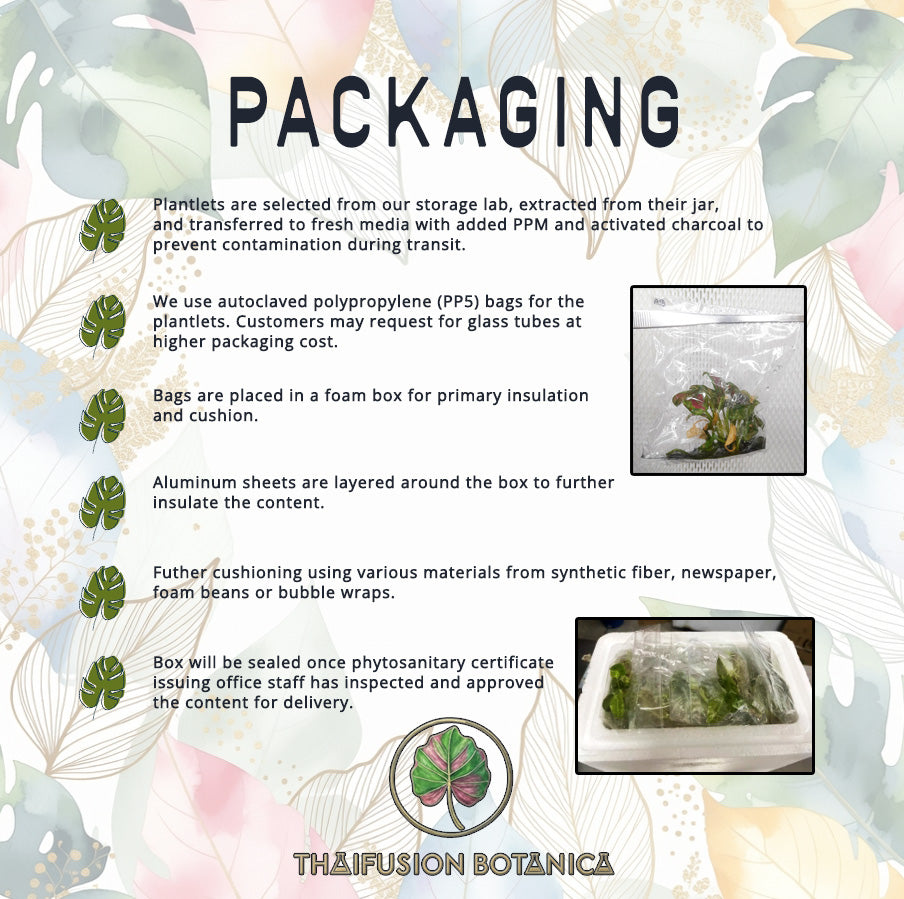
We ship our tissue culture plants in foam box lined with insulating material to minimize thermal shock.

Live plants are shipped in carton boxes with ventilation holes to prevent excessive moisture from building inside the parcel.

Please refer to our Delivery & Packaging page for more details. We do not recommend importing live plants if your area experiences temperature below -5 degree Celsius.

Disclaimer

Our photos are representative examples of the plants we offer. You will receive a healthy plant of similar size and quality unless the product description clearly states that the listing is for the exact plant shown.

For selected products, actual photos of the individual plant are provided. These listings will be clearly identified, and you will receive the exact plant pictured. The date the photos were taken will also be stated. If the photos are older, you are welcome to contact us to request updated images before purchasing.

Tissue culture plants are young plants and may not yet display their full mature characteristics. In variegated cultivars, variegation often becomes more pronounced as the plant matures under suitable growing conditions. However, the amount and pattern of variegation naturally varies from plant to plant and cannot be guaranteed.

Decorative pots and accessories shown in product photos are for display purposes only and are not included unless otherwise stated.

As our plants are living products, natural variation should be expected. Differences in size, leaf count, coloration, variegation, veining, and growth habit may occur depending on the season, age of the plant, environmental conditions, and normal biological variation. These natural differences are not considered defects and are not grounds for complaints, returns, or refunds.

All sales are final once plants have been shipped. Refunds or replacements for plants that arrive dead on arrival (DOA) are available only when the conditions outlined in our Returns, Refunds & Replacement Policy have been met. Please refer to that policy for full details.

View full details
  • Light

    Alocasias thrive in bright, indirect light. A position near an east- or west-facing window is ideal, where they receive plenty of filtered sunlight throughout the day. Avoid prolonged direct afternoon sun, which may scorch the foliage, while insufficient light can lead to slower growth and smaller leaves.

  • Temperature

    Alocasias perform best in temperatures between 20–30°C (68–86°F). Avoid prolonged exposure below 15°C (59°F), as cold temperatures can slow growth and damage foliage.

  • Water

    Keep the growing medium consistently moist but never waterlogged. Water thoroughly when the top 2–3 cm (1 inch) of the substrate begins to dry. Reduce watering slightly during cooler months while preventing the soil from completely drying out.

  • Humidity

    Alocasias are tropical plants that flourish in moderate to high humidity. Aim for 60–80% humidity for vigorous growth and larger foliage. In drier environments, consider using a humidifier or placing the plant near other tropical plants to create a more humid microclimate.

  • Potting Mix

    Use a chunky, well-draining aroid mix that provides excellent aeration while retaining adequate moisture. A blend containing coco coir or peat, orchid bark, perlite, and pumice works exceptionally well.

  • Fertilizer

    Feed every 2–4 weeks during active growth with a balanced liquid fertilizer diluted to half strength. Reduce feeding during winter when growth naturally slows.