ThaiFusion Botanica
Alocasia Nobilis Pink "K" Variegated
Couldn't load pickup availability
The leaf that gave this plant its common name, the kris plant, is the same leaf that makes it so hard to look away from: a deeply lobed, wavy-edged blade shaped like the undulating steel of a Southeast Asian kris dagger, held upright on a tall petiole with real architectural presence. On the Nobilis Pink "K" Variegated, that already-dramatic silhouette carries soft pink and cream sectoring through the veins and margins of an otherwise dark, glossy green leaf — a variegation pattern that reads as fine linework rather than a bold splash, and one that changes subtly from leaf to leaf.
Why collectors love it
Most pink-variegated Alocasia are chased for colour alone. This one earns its place in a serious collection on structure as well — the wavy, scalloped lobing and glossy near-black base leaf are traits of the species itself, long prized in botanical illustration and ornamental horticulture well before pink forms of it existed. The pink variegation sits on top of that inherited form rather than replacing it, so the plant reads as refined and considered instead of simply colourful. Growers of the "K" line have also reported that its pink tends to hold with maturity, rather than fading back toward plain green-on-green as some pink-variegated Alocasia can — a meaningful point of difference for anyone who has watched a prized pink plant slowly revert.
Botanical background
The "Nobilis" trade name traces to Alocasia sanderiana, a species native to the forest floor of Northern Mindanao in the Philippines, where it grows in the damp shade of primary and secondary forest. In the wild it is now classified as critically endangered, and collecting wild specimens in the Philippines is illegal — all the more reason its ornamental popularity today rests entirely on cultivated and tissue-cultured lines rather than wild collection. The species' defining trait, the wavy, sword-like leaf margin, is where the "kris plant" name comes from, and its leaves are peltate: the petiole attaches to the underside of the leaf blade rather than its edge, a structural detail botanists use to distinguish it from similar-looking Alocasia species.
Growing conditions
This is a forest-understory plant that wants filtered warmth rather than harsh sun: bright, indirect light, consistently moist but well-draining substrate, and humidity on the higher side. It isn't a difficult plant to keep, but it does reward attentive care — steady humidity and even light exposure will do more for the definition of its variegation than anything else you can offer it.
Closing
Bring this Nobilis Pink "K" Variegated into your growing space, and you're taking on a plant that pairs one of the aroid world's most distinctive natural leaf forms with a variegation line collectors specifically seek out for its staying power. ThaiFusion Botanica ships this plant from our nursery in Thailand with a phytosanitary certificate, ready to settle into your collection.
Shipping
Shipping
We ship our plants with free Phytosanitary Certificate via the national postal services, Dragon Courier and courier companies such as DHL and UPS. Some countries require an import permit.
Please refer to our Delivery & Packaging page for more details. We do not ship on public holidays in the Kingdom of Thailand.
Packaging
Packaging
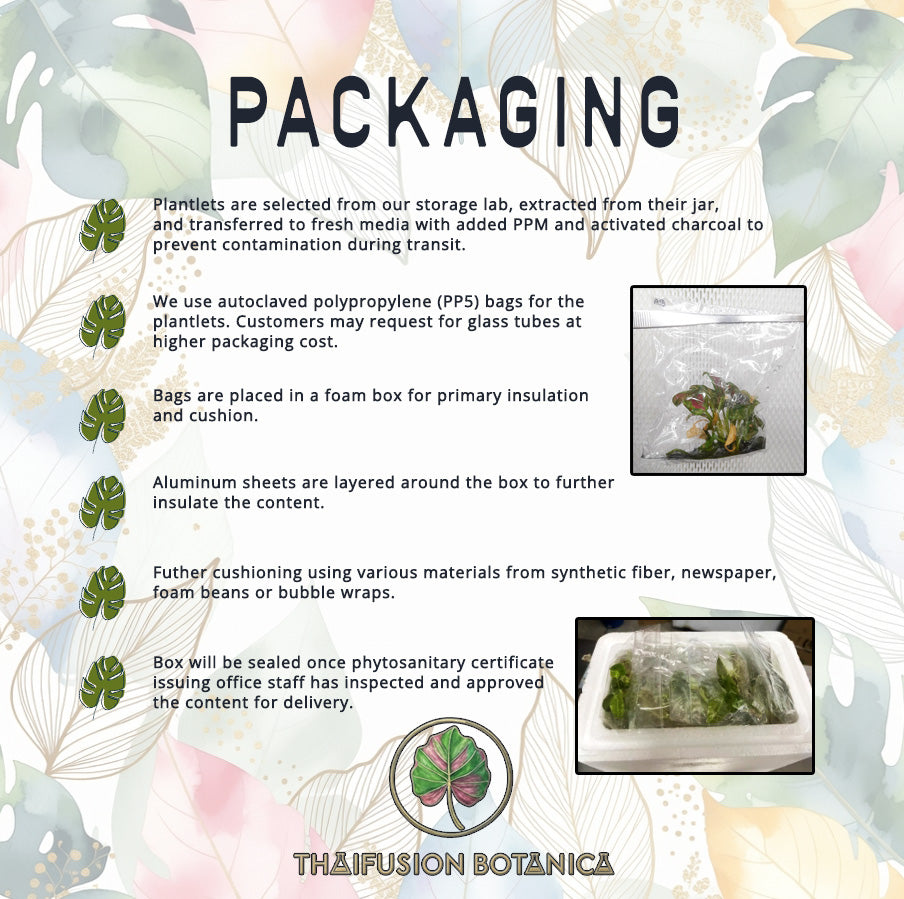
We ship our tissue culture plants in foam box lined with insulating material to minimize thermal shock.
Live plants are shipped in carton boxes with ventilation holes to prevent excessive moisture from building inside the parcel.
Please refer to our Delivery & Packaging page for more details. We do not recommend importing live plants if your area experiences temperature below -5 degree Celsius.
Disclaimer
Disclaimer
Our photos are representative examples of the plants we offer. You will receive a healthy plant of similar size and quality unless the product description clearly states that the listing is for the exact plant shown.
For selected products, actual photos of the individual plant are provided. These listings will be clearly identified, and you will receive the exact plant pictured. The date the photos were taken will also be stated. If the photos are older, you are welcome to contact us to request updated images before purchasing.
Tissue culture plants are young plants and may not yet display their full mature characteristics. In variegated cultivars, variegation often becomes more pronounced as the plant matures under suitable growing conditions. However, the amount and pattern of variegation naturally varies from plant to plant and cannot be guaranteed.
Decorative pots and accessories shown in product photos are for display purposes only and are not included unless otherwise stated.
As our plants are living products, natural variation should be expected. Differences in size, leaf count, coloration, variegation, veining, and growth habit may occur depending on the season, age of the plant, environmental conditions, and normal biological variation. These natural differences are not considered defects and are not grounds for complaints, returns, or refunds.
All sales are final once plants have been shipped. Refunds or replacements for plants that arrive dead on arrival (DOA) are available only when the conditions outlined in our Returns, Refunds & Replacement Policy have been met. Please refer to that policy for full details.
Share

Plant Care
-
Light
Alocasias thrive in bright, indirect light. A position near an east- or west-facing window is ideal, where they receive plenty of filtered sunlight throughout the day. Avoid prolonged direct afternoon sun, which may scorch the foliage, while insufficient light can lead to slower growth and smaller leaves.
-
Temperature
Alocasias perform best in temperatures between 20–30°C (68–86°F). Avoid prolonged exposure below 15°C (59°F), as cold temperatures can slow growth and damage foliage.
-
Water
Keep the growing medium consistently moist but never waterlogged. Water thoroughly when the top 2–3 cm (1 inch) of the substrate begins to dry. Reduce watering slightly during cooler months while preventing the soil from completely drying out.
-
Humidity
Alocasias are tropical plants that flourish in moderate to high humidity. Aim for 60–80% humidity for vigorous growth and larger foliage. In drier environments, consider using a humidifier or placing the plant near other tropical plants to create a more humid microclimate.
-
Potting Mix
Use a chunky, well-draining aroid mix that provides excellent aeration while retaining adequate moisture. A blend containing coco coir or peat, orchid bark, perlite, and pumice works exceptionally well.
-
Fertilizer
Feed every 2–4 weeks during active growth with a balanced liquid fertilizer diluted to half strength. Reduce feeding during winter when growth naturally slows.