ThaiFusion Botanica
Alocasia Melo Albo Variegated
Couldn't load pickup availability
Where the aurea form of this species wears gold, the albo form wears frost. Alocasia Melo Albo Variegated carries the same thick, deeply corrugated, almost stone-like leaves that define the species, but here the variegation runs crisp white to creamy alabaster against a blue-green to jade base; laid down in irregular sectors, marbling, or half-moon patterns rather than any repeating design. Held on a compact, upright plant, each leaf's heavy ribbing catches light differently depending on how the white sections fall across it, so the same plant can look subtly different from one viewing angle to the next.
Why collectors love it
White, or "albo," variegation is the most demanding form a plant can produce: the affected tissue contains no chlorophyll at all, rather than a reduced amount, which is why albo sections can't photosynthesize and why heavily variegated albo leaves are genuinely more fragile than their green counterparts. On most Alocasia that fragility plays out on a thin, easily stressed leaf. On Melo, it plays out on one of the thickest, most leathery leaf structures in the genus; a structural toughness that gives the white variegation a rare kind of support system, and part of why this particular cross of species and variegation type draws such attention from collectors who already know how difficult albo forms can be to keep looking good.
Botanical background
Alocasia melo is native to Sabah, on the island of Borneo in Malaysia, where it grows as one of the genus's naturally compact species. Its name comes from the English word "melon," a nod to the thick, wrinkled, faintly convex leaf texture that has long drawn comparisons to a cantaloupe's rind. That dense, leathery structure is generally understood as an adaptation for moisture retention, letting the plant hold up under brighter, more open conditions than the deep-shade understorey many Alocasia favor, which is also, incidentally, why variegated Melo forms tend to want more light than the average Alocasia to keep their patterning well defined. Melo belongs to the loosely grouped "Jewel Alocasia," a set of smaller-growing species suited to cabinet and terrarium culture rather than floor-plant scale.
Growing conditions
This plant wants bright, indirect light, genuinely important here, since insufficient light both dulls the white variegation and slows the plant's ability to support it. Beyond that, an airy, fast-draining aroid mix, warm and stable temperatures, and moderate to high humidity will keep it settled. Because the white leaf tissue can't photosynthesize, avoid letting the substrate swing between fully soaked and bone dry; consistency does more for this plant than any single care adjustment.
Closing
Bring this Melo Albo Variegated into your collection, and you're taking on one of the more technically demanding (and technically rewarding) forms in the Alocasia world, where a naturally tough, textured leaf structure gives a difficult variegation type real staying power. ThaiFusion Botanica ships this rare tropical plant from our nursery in Thailand with a phytosanitary certificate, ready to take its place among your collector aroids.
Shipping
Shipping
We ship our plants with free Phytosanitary Certificate via the national postal services, Dragon Courier and courier companies such as DHL and UPS. Some countries require an import permit.
Please refer to our Delivery & Packaging page for more details. We do not ship on public holidays in the Kingdom of Thailand.
Packaging
Packaging
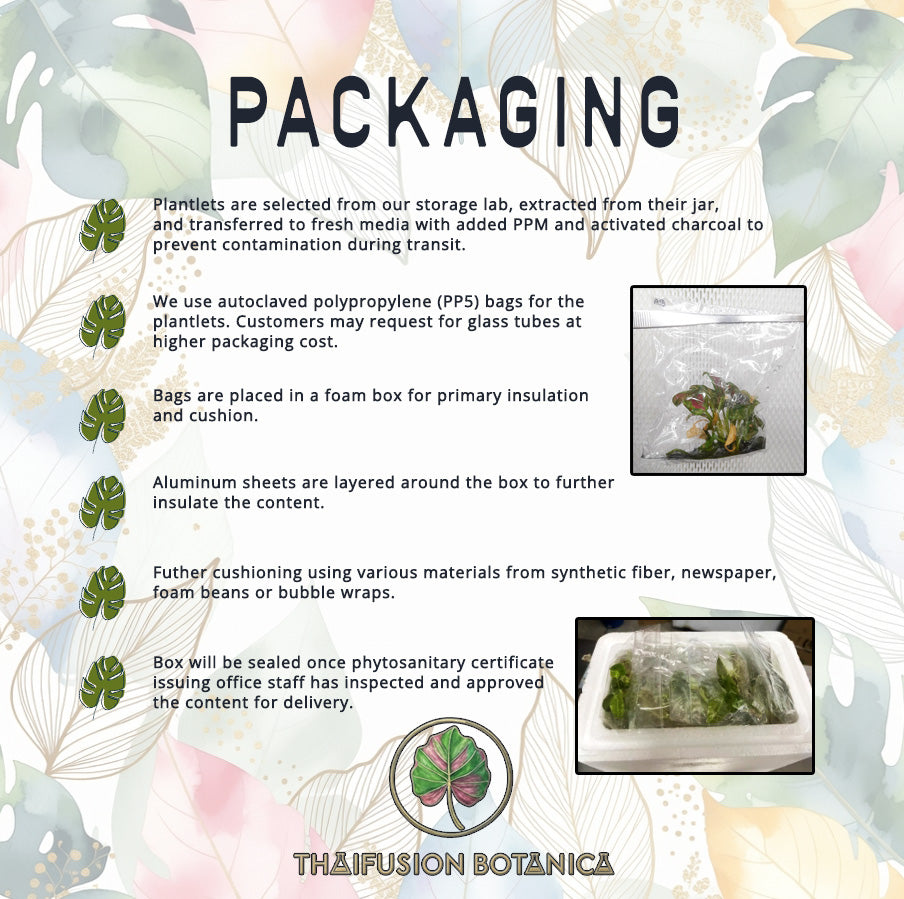
We ship our tissue culture plants in foam box lined with insulating material to minimize thermal shock.
Live plants are shipped in carton boxes with ventilation holes to prevent excessive moisture from building inside the parcel.
Please refer to our Delivery & Packaging page for more details. We do not recommend importing live plants if your area experiences temperature below -5 degree Celsius.
Disclaimer
Disclaimer
Our photos are representative examples of the plants we offer. You will receive a healthy plant of similar size and quality unless the product description clearly states that the listing is for the exact plant shown.
For selected products, actual photos of the individual plant are provided. These listings will be clearly identified, and you will receive the exact plant pictured. The date the photos were taken will also be stated. If the photos are older, you are welcome to contact us to request updated images before purchasing.
Tissue culture plants are young plants and may not yet display their full mature characteristics. In variegated cultivars, variegation often becomes more pronounced as the plant matures under suitable growing conditions. However, the amount and pattern of variegation naturally varies from plant to plant and cannot be guaranteed.
Decorative pots and accessories shown in product photos are for display purposes only and are not included unless otherwise stated.
As our plants are living products, natural variation should be expected. Differences in size, leaf count, coloration, variegation, veining, and growth habit may occur depending on the season, age of the plant, environmental conditions, and normal biological variation. These natural differences are not considered defects and are not grounds for complaints, returns, or refunds.
All sales are final once plants have been shipped. Refunds or replacements for plants that arrive dead on arrival (DOA) are available only when the conditions outlined in our Returns, Refunds & Replacement Policy have been met. Please refer to that policy for full details.
Share

Plant Care
-
Light
Alocasias thrive in bright, indirect light. A position near an east- or west-facing window is ideal, where they receive plenty of filtered sunlight throughout the day. Avoid prolonged direct afternoon sun, which may scorch the foliage, while insufficient light can lead to slower growth and smaller leaves.
-
Temperature
Alocasias perform best in temperatures between 20–30°C (68–86°F). Avoid prolonged exposure below 15°C (59°F), as cold temperatures can slow growth and damage foliage.
-
Water
Keep the growing medium consistently moist but never waterlogged. Water thoroughly when the top 2–3 cm (1 inch) of the substrate begins to dry. Reduce watering slightly during cooler months while preventing the soil from completely drying out.
-
Humidity
Alocasias are tropical plants that flourish in moderate to high humidity. Aim for 60–80% humidity for vigorous growth and larger foliage. In drier environments, consider using a humidifier or placing the plant near other tropical plants to create a more humid microclimate.
-
Potting Mix
Use a chunky, well-draining aroid mix that provides excellent aeration while retaining adequate moisture. A blend containing coco coir or peat, orchid bark, perlite, and pumice works exceptionally well.
-
Fertilizer
Feed every 2–4 weeks during active growth with a balanced liquid fertilizer diluted to half strength. Reduce feeding during winter when growth naturally slows.